
the UK Dining Guide
the UK Dining Guide

Les Célébrités
Hotel Nikko Osaka
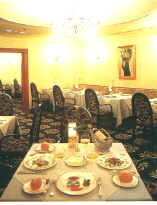 The European style
restaurant Les Célébrités is one of five
different dining rooms in this 32 story luxury hotel. The
decor is not particularly exciting, indeed you might even be put off by a
casual glance at the carpet and the chairs whose patterns clash,
but then you'd miss some great cooking by a first rate Japanese chef with a
very keen brigade and a sommelier who is both knowledgeable and
entertaining. Indeed, his wine list must be one of the most
comprehensive in Japan.
The European style
restaurant Les Célébrités is one of five
different dining rooms in this 32 story luxury hotel. The
decor is not particularly exciting, indeed you might even be put off by a
casual glance at the carpet and the chairs whose patterns clash,
but then you'd miss some great cooking by a first rate Japanese chef with a
very keen brigade and a sommelier who is both knowledgeable and
entertaining. Indeed, his wine list must be one of the most
comprehensive in Japan.
We go on a lot about so-called fusion cuisine in the West. It began with Chefs from France, the UK, Australia and so on doing their stints in the grand hotels of the far East and then combining many different styles and ingredients with varying degrees of success. It was interesting, therefore, to observe Maître Chef Hiroyuki Sasaki approaching culinary fusion from the opposite direction, as it were. He does what good and inventive chefs do, which is to take local ingredients and apply his own technique to their preparation. In M. Sasaki's case this is sound French Haute Cuisine wedded to that natural delicacy and restraint that is typical of Japanese cooking. So, for instance his menu degustation began, (after a neat amuse-bouche of salmon cream in choux pastry) with a rather unusual and delicious pressed terrine. It was made from the traditional juxtaposition of chicken and leeks combined with the more unusual addition of eel - a very popular fish in Japan - as well as a delicate flavouring of what I took to be wasabi, but which turned out to be a closer relative of horseradish.
This menu degustation, appropriately called La Mer, included four such interesting and creative fish courses. Next we were offered a Gateau moelleux de turbos et pommes terre. I wrongly assumed turbos was a misprint for turbot, so I was surprised and delighted by a kind of fish cake made from potatoes and the turbos which were like a sweeter and more tender variety of whelk. The third fishy offering was a very prettily fashioned quennelle of sea bream artfully presented with wild asparagus and a little caviar topping - real of course - cunningly made to resemble a miniature bunch of grapes. The piece de resistance of this piscine procession was a cuttle fish steak, the flesh cross-hatched in the traditional manner, served in a rich black sauce made from the sepia ink. It was rich and delicious and made everyone's lips and tongues go black! A tinglingy icy granita was found to be rather more effective than the more usual sorbet for restoring the palate after this exciting array of delicacies.
For the main course there was a choice between more fish, lobster this time, or Matsusaka beef. During my two week visit to Japan, I travelled about a lot, but I never saw one cow, sheep or any other livestock. There were plenty of fish tanks, (my friend's lobster had been hauled out of one immediately prior to its being cooked), but no visible cattle. I was told that they all lived in special hotels, waited on hand and foot and massaged daily. I'd love to believe this charming myth. But whatever the reality of their condition in life, the meat from such Japanese cattle is the most tender and beautifully marbled I've ever come across. The cooking enhanced it further; the surfaces were well browned and the inside was very pink and juicy. The lobster looked pretty good in its half shell - I imagine it must have tasted good too, with its rich wine Bordelais sauce, because it disappeared so damn fast that I didn't get a chance to try it!
There was a very good selection des fromages, not vast in number, but well kept and nicely ripe. Desserts came from another trolley. The Japanese are very keen on French patisserie; even in the smaller towns I saw shops selling rather gaudy looking tartes and gateaux. These were a little more restrained and benefited from having been made by the hotel's award winning maître patissier. I particularly enjoyed his petits fours which came with the coffee.
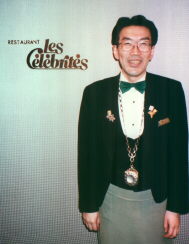 During all this we were regaled with a procession of magnificent wines.
As luck would have it, our visit coincided with a special promotion called
California Dreaming, so head sommelier Makoto Higuchi
right, proposed a selection of tasting glasses to match the principal
courses.
During all this we were regaled with a procession of magnificent wines.
As luck would have it, our visit coincided with a special promotion called
California Dreaming, so head sommelier Makoto Higuchi
right, proposed a selection of tasting glasses to match the principal
courses.
Whilst admiring the comprehensive nature of the list with M. Higuchi, I happened to remark how much I loved the Beaucastel 1990 Chateauneuf-du-Pape which appeared on his list for ¥en 20,000 (about 90 pounds at currently volatile exchange rates). A very young lady at the next table must have overheard me, for she summoned M. Higuchi and sent over the remains of her table's bottle of the white Beaucastel from that same year for us to try. I had never tasted it before and I was quite overwhelmed by the depth of flavour and the wonderful aroma and taste of roasted hazelnuts. What a very kind and generous gesture on the part of the young lady, and how greatly was it appreciated!
To give you an idea of the cost of top class wines in such a Japanese
restaurant, there was La Mission Haut Brion 95 for ¥13k - the 82 goes for
¥40k. Chateau Certan 86 costs ¥16k as does a 1er Cru Gevrey Chambertin,
 while Clos de l'Echo and Mouton Cadet 95 cost ¥7.5k and ¥5k respectively.
Altogether the 300 strong list is as comprehensive as any I've seen in one
and two starred Michelin establishments.
while Clos de l'Echo and Mouton Cadet 95 cost ¥7.5k and ¥5k respectively.
Altogether the 300 strong list is as comprehensive as any I've seen in one
and two starred Michelin establishments.
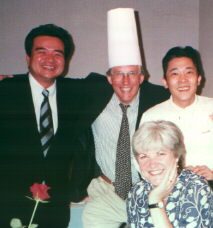
As for the cost of your meal itself, there are set menus ranging from ¥3500 to ¥7500 at lunchtime, and from ¥8000 to ¥16500 at dinner. Eating a la carte, starters are mostly in the range ¥3000 - ¥4000, and main courses ¥4000 to ¥5000. An average priced meal with a less expensive wine would cost the equivalent of about 75 pounds. Eating out in such high class Western restaurants in Japan has never been cheap, but since the recent slide of the Yen it is beginning to be more affordable. If you are in Osaka-Kobe-Kyoto, this is definitely one to check out. Pictured above left The Editor in silly hat with wife and Japanese friend together with Maître Chef Hiroyuki Sasaki.
Les Célébrités at the Hotel Nikko Osaka
Shinsaibashi, Chuo-ku, Osaka,
Japan
Restaurant open 11.30 - 14.30 and 17.30 - 22.00
Tel: 06 244
2472
If you have visited Les Célébrités, please send your comments to: Dine-Online
Dine Online Copyright Clifton Media Associates June 1998, All
rights reserved.