Portuguese Table Wine - a style of its own
Clifford Mould recently visited Portugal to see (and taste) the revolution in table wines.
In this first article of his new series on Portuguese table wines, he visits wine making giant Sogrape's new winery in Dão
Well known wine regions can fast become the victims of their own success. Equally, neighbouring regions or styles can be overshadowed by a great name, or even by hugely successful brand names. All these phenomena have been observed in Portugal whose most famous eponymous beverage conjures up a kaleidoscope of images to the British imagination: gentlemen's clubs - after dinner speeches - crusted bottles of ancient and prized nectar - stilton cheese and even elderly Cockney ladies whose favourite tipple was Port and lemon!
Red table wines from Portugal have inevitably been overshadowed by Port wine, which itself comes in so many subtly differentiated guises. But the success of two light table wines should not be underestimated in this story. Mateus Rose, the lightly sparkling pink wine in the flask shaped bottle was one of the great marketing marketing triumphs of the sixties. Nowadays it's all too easy to sneer at dear old Mateus Rose, but from this distance in time I still have affectionate memories of a charming seductress who initiated many a youngster into the pleasures of vinous pastimes! A decade later, Vinho Verde provided an important step towards greater sophistication for those newly weaned off Liebfraumilch. Upon such successes was the mighty Sogrape empire established, having been founded originally in 1942 by Fernando Guedes. Of course Sogrape also makes "normal" red and white table wines in the Douro, Dão, Barraida and Vinho Verde regions. A staggering 85% of their entire production is exported to 125 countries world-wide, and over a third of Portugal's wine exports come from Sogrape.
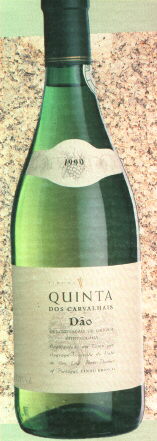
Sogrape's most exciting development in the 1990s has been an important new winery amidst the vineyards of the Quinta dos Carvalhais in the heart of the Dão region. Hiding amongst the trees of the estate is a large wine factory with row upon row of steel tanks and the spaghetti of pipe-work running in every direction. Sogrape's presence in Dão goes back to 1957, but it is here at Quinta dos Carvalhais that they have invested heavily in the latest high-tech plant, laboratories and computer control. Running in parallel has been the other even more important task, that of establishing some really good vineyards with the best possible examples of local grape varieties. It is the legacy of so many indigenous grape varieties that differentiates Portuguese table wines from those of the rest of world. When these unique varietals are grown, tended and harvested with real enthusiasm and care, we are beginning to find wines of great charm and individuality of expression.
At Carvalhais some 40ha of the 120ha estate have already been planted with vines and by the year 2001 they expect to have some 80 hectares under vines. But this home grown fruit is still not enough to satisfy the giant appetite of all those tanks. The company relies heavily on local growers for additional fruit, but the rules of engagement have changed and the relationship between the company and the growers is being developed all the time. Instead of paying for sugar content and quantity, the accent now is on quality and variety. Sogrape's viticultural team is working closely with many local growers, many of whom own small, traditionally operated family plots whose average size is around half a hectare. Apart from the expertise available to them, there are other benefits such as insurance against hail and flooding which encourages far more rigorous selection of fruit in years when the harvest is a bit up and down.
The Quinta do Carvalhais plant is divided into two main sections. There is a large wine factory where the simpler wines are made in bulk, though I would emphasise that a great deal of care and planning goes into this the greater part of the operation. Then there is a smaller model winery where the reserve wines are made. In keeping with Portuguese traditions, the careful location of the site and the design of the plant enables gravity to be harnessed so as to avoid much of the rougher action of pumping. There are sufficient vats to enable the different varietals to be fermented separately. Careful blending is done later on, the valves, pumps and gravity feeds are all activated by remote control. The vats are bristling with receptors and continuous data is fed to the computer consoles that display information and charts about temperature, pH, sugar and alcohol content and activities such as pigeage and pumping over.
In the small winery some of the wine is fermented in barrel from mainly free run juice. Handling is kept as soft as possible, any pressing is done in the latest bladder presses. In the laboratory, I noticed many five-litre micro-fermentation vessels in which trials are carried out and new blends experimented with. Postgraduate students from UTAD and the Catholic University of Oporto spend valuable time at the plant - a visible manifestation of the degree of co-operation leading to the exchange of ideas and information between academics and practitioners. Just off the main labs is the tasting room, one of the best I've visited. You sit in little individual carrels, each with its light box for examining colour and clarity, plus a little drawer to one side that hides a spittoon (looking a little too uncomfortably like the ones at the dentist's!). You flush away your debris by pressing a foot pedal on the floor. We tasted quite a few interesting experimental wines made from single varieties such as Touriga Nacional and Tinta Roriz. Some were destined to be blended and others are being developed into new single varietal brands.
As the newly planted vineyards are now beginning to yield their first harvests, in future I shall certainly be on the look out for wines bearing the name Quinta do Carvalhais.
Sogrape Wines in the UK
In mid September, the results of the 1997 International Wine Challenge were announced. Portuguese wines scored a huge fistful of medals, including Red Wine of the Year. Sogrape were successful with a number of wines, and all of these are widely available in the UK
Silver Medal:
Sogrape Reserva Douro 1992, Stg 6.50
Bronze Medals:
Sogrape Vinho Verde Quinta de Azevedo 1996, Stg 5.00
Sogrape Douro Vila Regia 1995 Stg 3.99
Sogrape Dão Duque de Viseu 1992 Stg 6.00
Recommended Seal:
Sogrape Vinho do Monte Alentejo 1993, Stg 5.99
Co-op own label Barraida Tinto 1992 from Sogrape Stg 3.69
Safeway own label Barraida 1992 from Sogrape Stg 3.99
Co-op own label Dão 1994 from Sogrape Stg 3.59
Sogrape Esteva VQPRD 1995, Stg 3.15
Sogrape Vinha do Monte 1994, Alentejo Stg 6.00
If you have tasted any of the wines mentioned in our reviews, please let us have your comments:
dine@dine-online.co.uk
Dine Online Copyright Clifton Media Associates 1997, All rights reserved.