Michael Pelham enters
a fantasy world at
The Portmeirion Hotel in Wales
Portmeirion
- the hotel and village in North
Wales - is an extraordinary and
wonderful phenomenon. It was created
by the architect Sir Clough
Williams-Ellis, who had long
had a dream of building an ideal
village on some romantic coast.
He found a beautiful site on the
Aber penisula in 1925, the hotel
was opened in 1926 and the village
was completed in 1973, in time
for Sir Clough's 90th birthday.
It
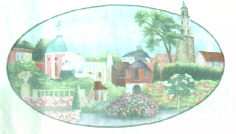
is pure theatre: an Italianate
village in miniature, nestling
in a North Wales valley looking
towards miles of golden sands -
when the tide is out. There is
a village square, with a pond and
fountain, a pantheon or dome, a
grotto, a campanile, a little Town
Hall, a triumphal arch, a number
of charming shops, including, of
course, one selling the famous
Portmeirion pottery. Accomodation
is available either in the main
hotel or in one of the many rooms
or suites or cottages dotted about
the village. It is unique and a
colourful delight and is surrounded
by 70 acres of sub-tropical woodland
gardens. There are said to be twenty
miles of paths criss-crossing the
woods, crags and valleys, many
of which lead to rocky coves and
sandy beaches all along the headland.
 Avid TV viewers may have already
seen Portmeirion, as Patrick McGoohan
found it the perfect location for
his television classic "The Prisoner".
Avid TV viewers may have already
seen Portmeirion, as Patrick McGoohan
found it the perfect location for
his television classic "The Prisoner".
Portmeirion has had its ups and
downs - the latter generally due
to temporary lack of funds - and
the hotel itself was destroyed
by fire in 1981. It has been brilliantly
rebuilt and delightfully and amusingly
furnished. The furnishings and
decoration of the rooms in the
hotel and in the village (which
is only three or four minutes walk
from the hotel) are of a very high
order and full of character. Everywhere
there is great comfort. All rooms
have private bath-rooms, television
and direct dial telephones. A few
years ago the village and its properties
looked somewhat tired but now everything
has been freshened up to a very
good standard.
The views from the rooms in the
hotel and in the village are for
the most part marvellous and in
some cases spectacular. The estuary
is very shallow and it is a great
delight to see the miles of sand
at low water changing shape quickly
as the tide comes in. You can see
this particularly well if you take
the delightful walk from the hotel
along the path, past a statue of
Lord Nelson turning a blind eye,
by rhododendrons and wild flowers,
to an imitation light-house by
a sandy bay. Or nearly as well
from the comfort of a window table
in the dining room.
The public rooms in the hotel
are unusual. There is a morning
room, in pale turquoise with an
extraordinary fire-place; a sort
of writing room with a big bow
window with seats along it; a bar
decorated like a Moorish tent and
the big curvilinear dining-room
- all with wonderful views of the
estuary.
But
man cannot live on views alone
and, I am delighted to say, the
food is very good and surprisingly
reasonably priced. I salute their
pricing policy which helps to ensure
a high occupancy rate in spite
of their remote location. I started
dinner with lobster bisque which
was full of flavour - generally
only achieved by ensuring that
there is no meanness with the lobster
and by adding a little ground-up
shell. My companion had an excellent
terrine of tuna and salmon with
a fennel and mustard dressing -
an unusual dish which was pronounced
excellent. Alternatives (we are
still on the first course) could
have been guinea fowl with taglietelle
of carrots and courgettes served
with a blueberry sauce; galia melon
with berries and caramelised apple;
smoked salmon with salad leaves.
For the main course I had something
called braised Henry of lamb with
a cassoulette of white beans. This
turned out to be a steak of lamb
taken from the shoulder and was
as good a piece of lamb as I have
eaten in a long time. It was full
of taste, tender and beautifully
and lightly cooked. The beans were
a fine accompaniment. My companion
had roasted monkfish wrapped in
Parma ham on a bed of Provencale
vegetables, olives and sun dried
tomatoes. The definite flavour
of monkfish was able to stand up
well to the unusual additions.
Alternatives would have been a
Welsh rib eye steak with oyster
mushrooms and pepper sauce; roast
loin of Brecon venison with a caramelised
onion tartlet, roasted tomatoes
and a herb topping; tranche of
salmon with prawns, asparagus and
a dill cream; a vegetarian dish
of mille-feuille of goats' cheese,
aubergine, spinach and tomato with
puff pastry and a celeriac cream;
loin of Welsh lamb with pak choi,
roasted radishes, cherry tomatoes
and mushroom caps.
From this one can see how inventive
the chef is (but not perversely
so!). Everything is attractively
presented and the food is served
hot on hot plates - which all too
often, sadly, doesn't happen.
The large number of Welsh farmhouse
cheeses are interesting and in
good condition and the puddings
include apricot mousse between
chocolate leaves (a splendid combination);
rhubarb crumble with its own sorbet;
honey and walnut mousse with a
chocolate sauce.
 The
wine list is extensive, indeed
distinguished, with many fine things
in it at very reasonable prices.
The house wines (3 red and 3 white)
are £10.50 and very decent.
House champagne, a blanc de noirs,
is good value at £24.50. There
is a long list of red Bordeaux
wines, some at near bargain rates
for a first class hotel: Grand-Puy-Lacoste
'92 at £25, for instance,
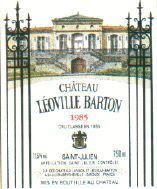
or Leoville-Barton '92 at £28.50
or Giscours '86 at £39, as
well as some more expensive wines
leading up to Lafite '83 at £110.
There are fine Burgundies too,
including a Gevrey Chambertin at £27.50
and a Chambolle-Musigny '94 at £39.
There are good white Burgundies,
including Chassagne-Montrachet
and Puligny-Montrachet and even
a Chambolle-Musigny. There are
wines from the Loire, from Italy,
Spain, Australia, California, Argentina,
Chile, Mexico South Africa and
the Lebanon. It really is a very
interesting list.
The
wine list is extensive, indeed
distinguished, with many fine things
in it at very reasonable prices.
The house wines (3 red and 3 white)
are £10.50 and very decent.
House champagne, a blanc de noirs,
is good value at £24.50. There
is a long list of red Bordeaux
wines, some at near bargain rates
for a first class hotel: Grand-Puy-Lacoste
'92 at £25, for instance,
or Leoville-Barton '92 at £28.50
or Giscours '86 at £39, as
well as some more expensive wines
leading up to Lafite '83 at £110.
There are fine Burgundies too,
including a Gevrey Chambertin at £27.50
and a Chambolle-Musigny '94 at £39.
There are good white Burgundies,
including Chassagne-Montrachet
and Puligny-Montrachet and even
a Chambolle-Musigny. There are
wines from the Loire, from Italy,
Spain, Australia, California, Argentina,
Chile, Mexico South Africa and
the Lebanon. It really is a very
interesting list.
Everyone should visit Portmeirion
(like Venice) at least once in
their life-time, but if you are
driving all the way to North Wales
you should try to stay for several
nights - not only because it is
a delight in itself but because
there are so many splendid things
to see near by. There are Caernarfon,
Harlech, Cricieth and Penrhyn Castles,
Powys castle with its splendid
gardens, Bodnant garden, Ffestiniog
railway and of course Y Wyddfa,
Mount Snowdon itself. You can walk
to the top of Snowdonia's highest
peak without too much difficulty,
if the weather is good, or you
can take the little mountain railway.
"Croeso!" they say to you when
you arrive at the gate-house at
Portmeirion, or "Welcome!", for
they are mostly bi-lingual here.
And one is indeed made to feel
welcome by all the staff at this
delightful place. I have stayed
here many times over the years
and and am always eager to return,
to walk again along the path by
the sea and to watch the movement
of the tide, before coming back
to a delicious dinner with a truly
memorable view.
- Michael Pelham, July 1998
The cost of your meal: A
two course dinner costs £25,
three courses for £30. And
the Welsh harpist who plays a proper
Welsh harp charmingly during dinner
is included!
The Hotel Portmeirion, Portmeirion,
Gwynedd LL48 6ET, Wales
Tel: 01766 770 228 Fax: 01766 771
331 e-mail: hotel@portmeirion.wales.com
Rooms start at £100 per room
per night. Two night breaks are
available at a discount.
Michael Pelham is proprietor
of Pelham Tours who organise
gastronomic, sporting and other
tours in the UK and in Europe.
Pelham Tours: Old Way House, Beaulieu, Hampshire SO42 7YL.
Tel: 01590 612264 Fax: 01590 612747. e-mail: peltours@interalpha.co.uk